

Why Is Greenland Strategically Important to the U.S.?
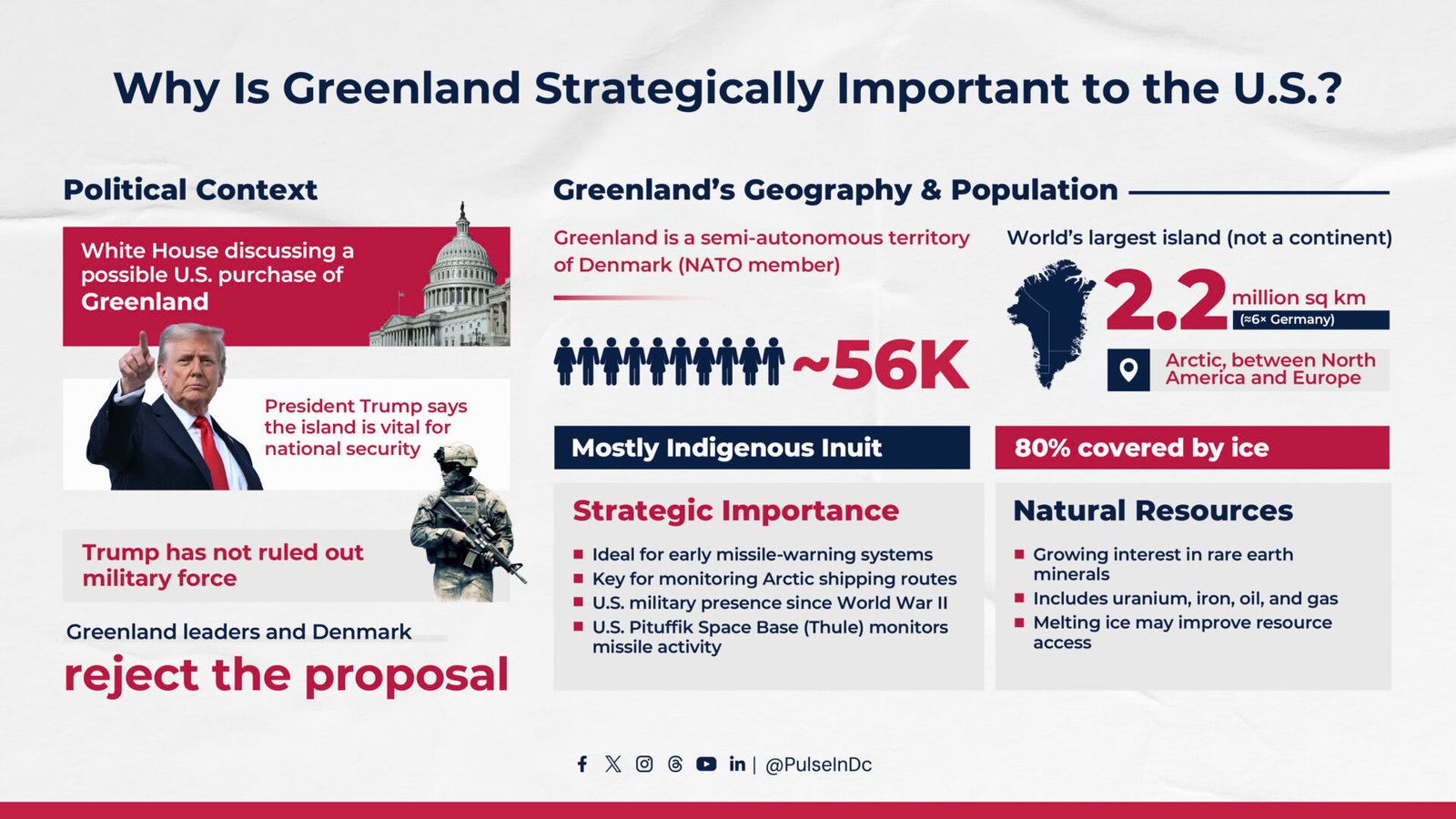
The White House has confirmed that it is actively discussing a potential U.S. offer to buy Greenland, reigniting a controversial idea promoted by President Donald Trump, who argues the Arctic island is essential to American national security.
Trump says Greenland’s location between North America and the Arctic makes it strategically vital for missile early-warning systems, military monitoring, and control of increasingly active Arctic shipping routes.
He has not ruled out the use of military force, a stance that has drawn strong rejection from Greenland’s leaders and from Denmark, a NATO ally that oversees the island as a semi-autonomous territory.
Greenland is the world’s largest island, roughly six times the size of Germany, yet it is home to only about 56,000 people, most of them Indigenous Inuit, and nearly 80% of its landmass is covered by ice.
The U.S. has maintained a military presence there since World War II, most notably at Pituffik Space Base, which plays a key role in missile detection and space surveillance.
While Greenland’s economy relies heavily on fishing and financial support from Denmark, global interest in its natural resources has grown as climate change accelerates ice melt, potentially opening access to rare earth minerals, uranium, iron, and possible oil and gas reserves.
Trump insists minerals are not the motivation, warning instead of growing Russian and Chinese activity in the Arctic, a concern shared by many Republican lawmakers who see the region as a new frontline in global power competition.