

Countries That Survive Without Armies
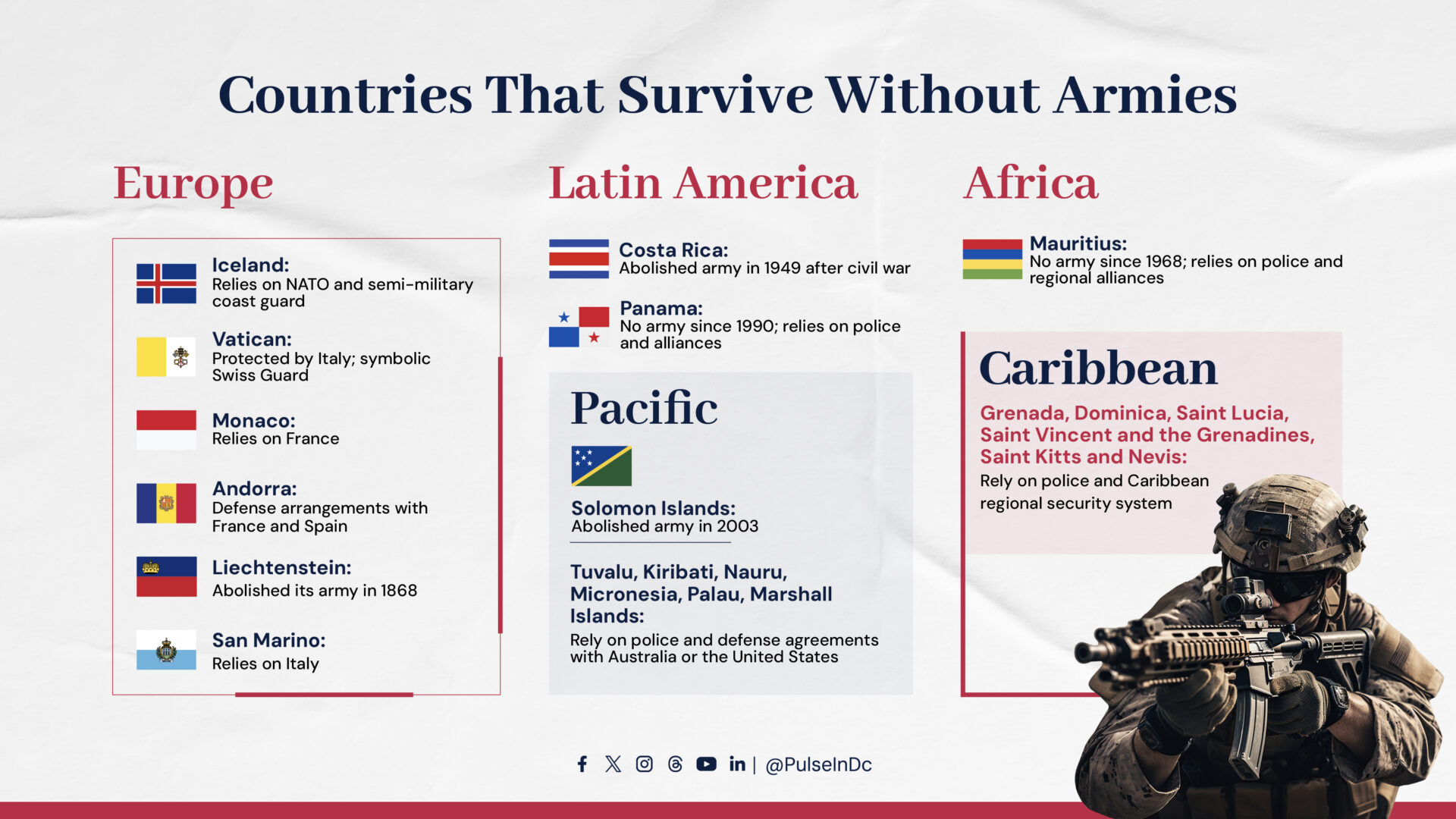
Several countries around the world have chosen not to maintain regular armies, relying instead on alternative security strategies such as alliances, police forces, or regional defense agreements.
In Europe, Iceland, Liechtenstein, Vatican City, Monaco, Andorra, and San Marino operate without full militaries. Iceland relies on NATO and its coast guard, while the Vatican maintains the Swiss Guard, which is largely ceremonial.
Monaco and San Marino depend on Italy for defense, and Andorra works with both France and Spain. Liechtenstein abolished its army in 1868, demonstrating that national safety can be maintained through diplomacy and partnerships rather than traditional military forces.
In Latin America, Costa Rica famously abolished its army in 1949 following a civil war, prioritizing police and international agreements for defense.
Panama has not maintained an army since 1990 and instead relies on police forces and strategic alliances to ensure its security.
In the Pacific region, nations such as the Solomon Islands, Tuvalu, Kiribati, Nauru, Micronesia, Palau, and the Marshall Islands rely on police forces and defense agreements with larger countries such as the United States or Australia.
Similarly, Mauritius in Africa has no army and depends on its police force along with regional security arrangements to safeguard the country.
In the Caribbean, nations including Grenada, Dominica, Saint Lucia, Saint Vincent and the Grenadines, and Saint Kitts and Nevis maintain security through police and the Caribbean Regional Security System.